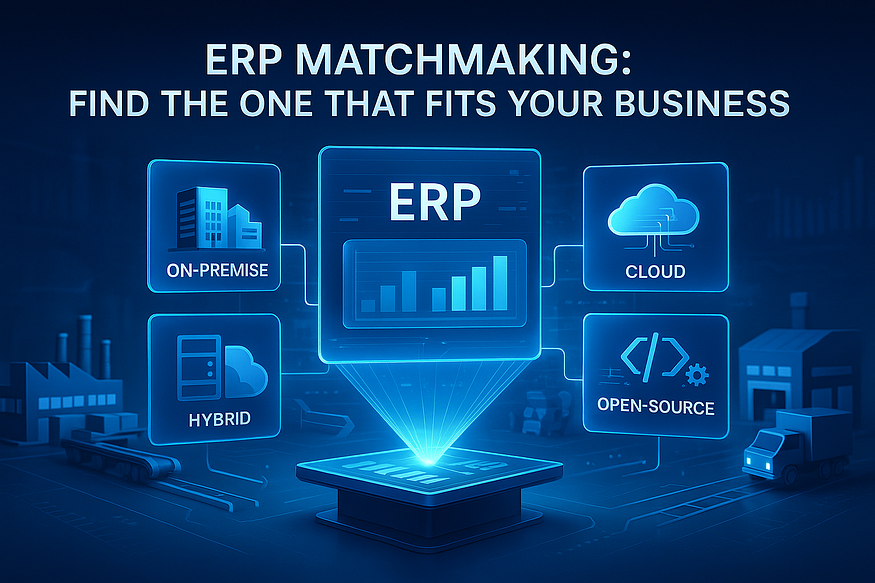
ERP Matchmaking: Find the One That Fits Your Business
iFive Technology Pvt. Ltd., based in Chennai, specializes in Business process automation solutions tailored to diverse business needs. Our product suite includes Enterprise Resource Planning (ERP), Human Resource Management System (HRMS), Customer Relationship Management (CRM), Industrial Internet of Things (IIoT) applications, and mobile apps. Additionally, we offer specialized tools like Advanced Product Quality Planning (APQP), Inventory Control, and Visitor Management systems and 10+ Softwares .
If you’ve ever tried shopping for an ERP system, you know it’s not as simple as picking software off a shelf. The type of ERP you choose can either become the backbone of your business or a costly headache you regret for years.
Why? Because every ERP is built differently. The wrong one could drown you in unused features, leave gaps in critical processes, or limit your ability to scale. The right one? It can give you total visibility over production, slash inefficiencies, and keep your business future-ready.
Let’s break down the types of ERP in a way that’s simple, practical, and manufacturer friendly.
1. On-Premise ERP
Best for: Large manufacturers with sensitive data and heavy customisation needs.
Pros:
Full control over data, configurations, and workflows
Strong security for intellectual property
Independent from third-party hosting uptime
Cons:
High upfront investment in hardware and licenses
Requires skilled in-house IT resources
Example: A heavy machinery manufacturer that needs custom production scheduling and in-house quality control.
2. Cloud ERP
Best for: Businesses that value quick deployment and minimal IT overhead.
Pros:
Lower upfront cost (subscription-based)
Automatic vendor-managed updates
Access from anywhere, great for multi-location plants
Cons:
Ongoing subscription costs
Dependent on stable internet connectivity
Example: An FMCG brand managing inventory across multiple warehouses in real time.
3. Hybrid ERP
Best for: Companies transitioning from older systems or needing both local security and cloud convenience.
Pros:
Keeps sensitive data on-site while using cloud modules for other functions
Enables phased migration without full disruption
Cons:
- More complex to manage due to dual environments
Example: An auto parts manufacturer storing design files locally but handling supplier orders in the cloud.
4. Open-Source ERP
Best for: Manufacturers with strong in-house IT teams and unique process needs.
Pros:
Low licensing cost
Complete freedom to customise modules
Cons:
Requires technical expertise
Limited official vendor support
Example: A precision engineering company integrating IoT machine data into customised production dashboards.
🚀 Want the full breakdown with real-world manufacturing scenarios, selection checklists, and expert tips?
Read our complete guide here ➡️ Types of ERP Systems: Which One Fits Your Business?